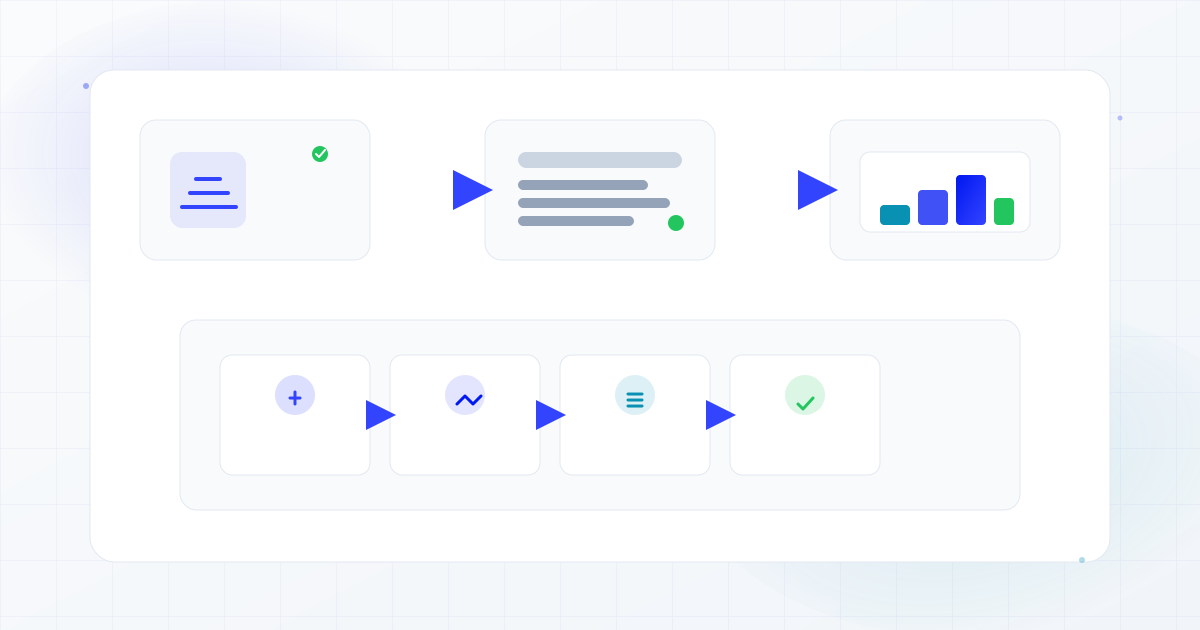

The telematics platform knows where the vehicle is. The ERP knows what it costs. The TMS knows what it is supposed to carry. Until those three talk to each other, somebody re-keys data between windows every month — and it is usually the person who should be doing something else.
We have been building Wialon integrations since 2017, from a simple mileage export into accounting through to two-way order exchange with TMS platforms.
Where the data comes from, and with what delay
Wialon exposes data in two ways, and the choice between them decides how the integration behaves when something fails.
Scheduled polling pulls a report or a data range every hour, every night or once a month. It tolerates a temporary loss of connectivity — the next run catches up — and it is enough wherever the recipient is accounting or a data warehouse.
Notifications are pushed by the platform at the moment of the event: entering a zone, crossing a threshold, an alarm. The delay is measured in seconds, but the recipient has to be reachable when it is sent, so the integration needs a queue or a buffer on the receiving side.
Two things are worth settling up front: how long raw data stays available for a re-fetch, and what happens to a record that arrives twice. Both surface later, usually at the first month-end close.
What usually breaks in an integration
Four failures we have seen most often — all of them predictable, and all detectable earlier than through a customer complaint.
A change on the other side. An ERP update changes a field format or its length. The integration stops on a Friday afternoon, and nobody is notified.
An expired token or a changed service account password. The most common cause of a silent gap in the exchange. This is why every integration gets its own service account rather than the account of an employee who may leave.
Duplicates after a retry. A delivery that received no acknowledgement is repeated — and without an idempotency key the same trip lands in billing twice.
Time zones and daylight saving. A reporting day counted in a different zone than the accounting day shifts mileage between months. It surfaces at the first quarter close.
Who maintains it after the rollout
An integration is not a project that ends on launch day — it is a service that lives as long as the systems on both sides keep changing. That is why every rollout ships with job monitoring and error alerts: a failure has to be visible before accounting notices it.
The client receives documentation, the field mapping and access to the code. If the company has its own IT team or changes supplier, taking over maintenance is a matter of handing over the repository, not of negotiation. Maintenance on our side is a service, not a condition for the system to keep running.
The starting point
The best first step is to name one report that is produced by hand today and count the hours it consumes over a year. That number frames the scope conversation — and tells you whether the integration is worth doing at all. The sequence is covered in the article on Wialon–ERP integration.
Frequently asked questions
Where should a Wialon–ERP integration start?
With one specific report that is produced by hand today — usually the monthly mileage summary or fuel cost per vehicle. Automating a single flow produces a measurable result within weeks and reveals which data is genuinely needed before larger architectural decisions are made.
Does Wialon have an open API?
Yes. Wialon Remote API works over HTTP/JSON and exposes units, sensors, trips, events and reports, along with a notification mechanism. That supports both scheduled data pulls and near-real-time reaction to events.
What if the company has no IT team?
We run the project end to end: analysis, build, maintenance and support. The customer receives documentation and code access, so taking maintenance in-house or moving it to another supplier stays possible at any point.
How is data security handled?
HTTPS with scoped tokens, a separate service account per integration, call logging and retention aligned with the customer's policy. Driver personal data is passed only to the extent a specific process requires.
How long does a typical integration take?
A one-way export of a single report into an ERP is usually two to four weeks from sign-off on the specification. A two-way exchange with a TMS covering orders and delivery statuses is a multi-month project, run in stages with a working result after each one.