



Asking what GPS tracking costs is like asking the price of a delivery van — the answer depends on what it has to do. Rather than publishing a range that would not fit your fleet, we break the cost into four components. You can estimate each of them before you speak to us.
Component 1: the device
The widest price spread in the whole calculation, because the functional gap between hardware classes is real:
| Class | What it gives | Typical use |
|---|---|---|
| Plug-and-play OBD tracker | Position, OEM fuel level, 32 engine parameters, no workshop needed | Cars and light commercial vehicles |
| Two-wire IP67 tracker | Position, 7–90 V supply, backup battery, BLE accessories | Motorcycles, scooters, cargo bikes, vehicles without OBD |
| CAN-based FMS unit | Full engine telematics, DTC codes, dual CAN bus | Trucks and tractor units |
| FMS with tachograph download | Automatic DDD file retrieval on the EU schedule | International transport |
| Video telematics | Road and cabin camera synchronised with GPS data | Fleets exposed to disputed incidents |
Accessories are priced separately: fuel level sensors, driver card readers, temperature sensors for reefers, BLE beacons for trailer identification.
Component 2: installation
Three scenarios at different cost:
- DIY — the OBD device is fitted by your own staff with instructions and remote support. Zero installation cost.
- Partner workshop — required for FMS units and fuel sensors, priced per vehicle.
- On-site at your depot — a crew comes to the fleet base, which makes sense when many vehicles sit in one place.
Worth counting the hidden cost too: the time a vehicle spends not earning while it is in the workshop. For FMS installs that is usually a few hours per vehicle, which is why we schedule so vehicles come off the road one at a time.
Component 3: connectivity
The device sends data over the mobile network. Two options: a SIM from us with a plan matched to the device profile (1NCE or a Polish carrier, with European roaming), or your own corporate SIM — in which case this line disappears from our quote and stays in your carrier contract.
For fleets running outside the EU this is a material line: check roaming rates before the device goes into a vehicle heading east.
Component 4: platform licence
Billed monthly per active unit, in three variants:
- Wialon Hosting — SaaS, fastest to deploy, no infrastructure cost. The default for most fleets.
- Wialon Platform — self-hosted or white-label. Justified at scale or where data residency requirements apply.
- GPS-Trace — a lighter platform for very small fleets.
Configuration, report templates, geofences, team training and technical support are part of the rollout — not a separate invoice line.
CAPEX or OPEX
Buying the hardware. Higher upfront cost, lower monthly rate. Worth it for a stable fleet with a planning horizon beyond three years.
Subscription with the device included. No upfront investment, higher monthly rate. The natural choice for leased, growing or rotating fleets.
Mixed fleets often run both models in parallel — purchase for owned vehicles, subscription for leased ones.
How to prepare for a quote
To get a concrete offer within 24 hours we need four things:
- A vehicle list split by type: cars, vans, trucks, trailers, machinery.
- Required functionality — location only, or fuel, tachograph, temperature, video.
- Commercial model — purchase or subscription.
- Horizon — whether the fleet is expected to grow within the year.
From that we prepare a quote covering devices, installation, SIM cards and licences, split into year one and the years after. If you would rather see your own data first, we start with a demo on one vehicle in full configuration.
Working out the annual cost
A monthly per-vehicle price is convenient in conversation and impossible to compare across offers — one includes the device, another does not, a third spreads installation over instalments. The comparable figure is annual cost per vehicle:
Purchase (CAPEX). Year one = device + installation + 12 × (connectivity + licence). Later years = 12 × (connectivity + licence), because the hardware is already paid for. Which is why buying is usually cheaper over a three-year horizon and more expensive over a one-year one.
Subscription (OPEX). Every year = 12 × an instalment covering hardware, connectivity and licence. There is no entry cost, but there is also no point at which the cost drops.
Two lines are easy to forget. The first is fleet turnover: a sold vehicle means removing the device and fitting it to the replacement, which is an extra cost under a purchase model. The second is configuration changes — new reports, new geofences, training another person. With us those sit inside support; with some suppliers they are billed hourly and can move the real annual figure noticeably.
Above a dozen or so vehicles it is worth costing both paths in parallel — over three years the gap between them is often wider than the gap between suppliers.
What actually drives the return
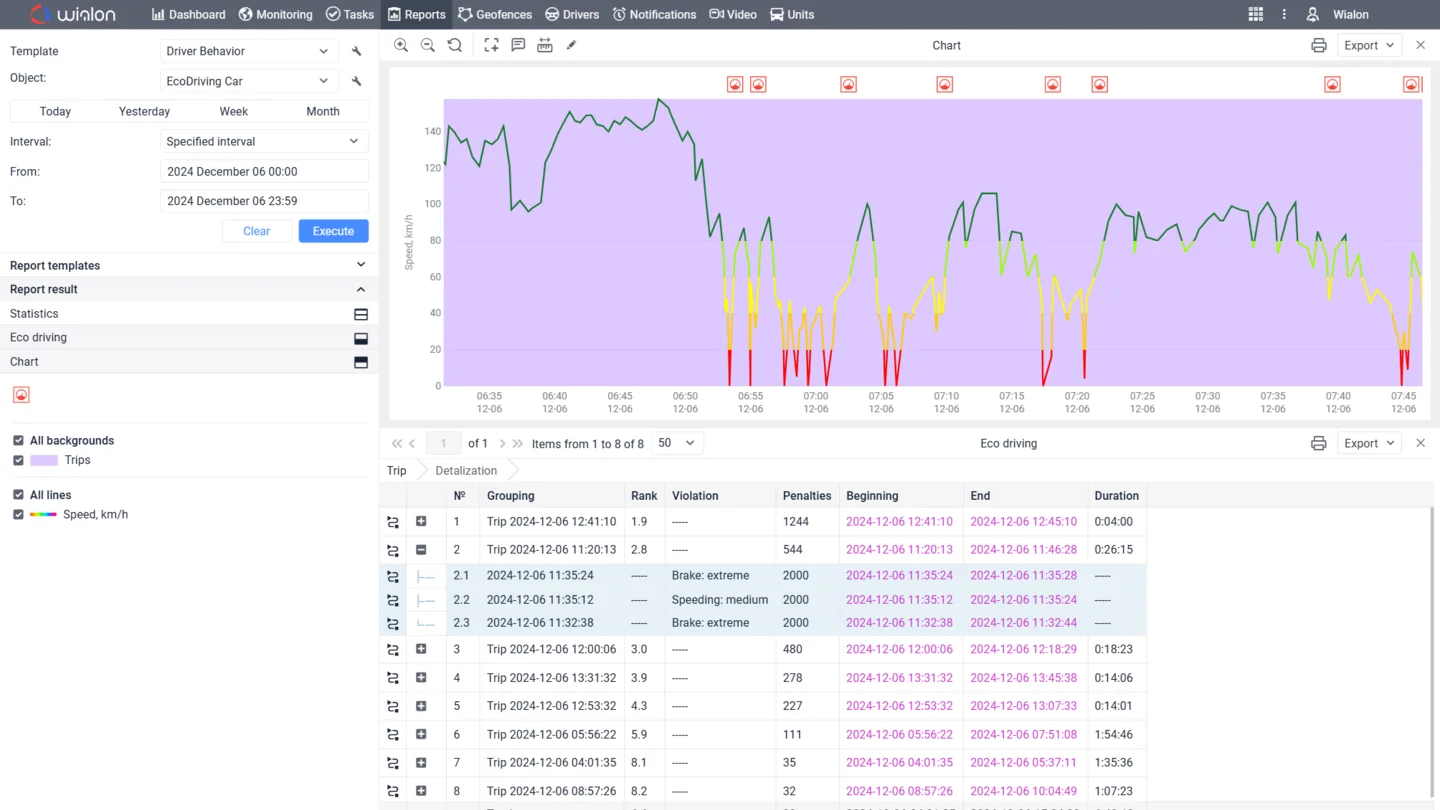
Cost is one side of the equation. The other is the savings attributable to the rollout: reduced fuel losses, less idling, fewer empty runs, faster driver settlement. We set out the method for calculating it — rather than a percentage promise — in the article on cutting fleet costs with telematics.
Frequently asked questions
How much does GPS tracking cost per vehicle per month?
It depends on four things: device class, installation method, data plan and platform licence. An OBD tracker in a delivery van and an FMS unit with tachograph download plus a fuel level sensor in a tractor unit are different orders of magnitude. That is why we quote a specific fleet rather than an abstract vehicle.
Do we have to buy the devices outright?
No. Both models are available: purchase, with a lower monthly cost, or a subscription with the device included in the service. For fleets on lease or with a short planning horizon, the second usually works out better.
Are installation and configuration charged separately?
Installation is quoted separately, because the difference between an OBD tracker and an FMS install wired to a tachograph is real. Platform configuration, report templates, geofences and team training are included in the rollout.
What about data connectivity?
Either a SIM from us with a plan matched to the device (1NCE or a Polish carrier), or your own corporate SIM — in which case the connectivity cost stays on your side and we simply provision the device.
What does fleet tracking cost per year?
The annual figure is three lines added together: the one-off spend in year one (devices and installation, if you buy them), twelve months of connectivity, and twelve months of the platform licence. On a subscription the first line disappears and the year costs exactly twelve instalments. When comparing offers we always reduce them to annual cost per vehicle — it is the only number that can be set side by side across suppliers.
Can we trial the system before committing?
Yes. The standard approach is one or two vehicles with the full configuration for a trial period. You see data from your own fleet, not a demo account, before deciding on scale.