



GPS fleet tracking starts with a dot on a map and ends somewhere else entirely: with a decision you make faster and with more confidence than your competitor. Which vehicle takes the urgent job. Whether the driver will make it inside their hours. Why one van burns 18% more fuel than an identical unit parked beside it.
We have worked on the Wialon platform since 2017 and write our own modules for it wherever the standard falls short. Here is what you get and how the path from first conversation to working system looks.
What the system records, and for how long
The device does not send a stream, it sends messages: position, speed, ignition, sensor states. The sending rules are set at configuration — every so many seconds, every so many metres, on a change of heading, or when a sensor crosses a threshold. Those rules decide whether a report shows the stop at a customer’s gate or only the drive past it.
History: twelve months as standard. Enough to settle a complaint, reconstruct an incident from six months ago, or close a mileage log for the previous tax year. Longer retention is possible, but it is a decision to be tied to a purpose — not a setting left on “just in case”.
Accuracy and its limits. Multi-constellation GNSS (GPS, GLONASS, Galileo, BeiDou) gives a few metres in the open. In dense blocks, under overpasses and in underground car parks the signal reflects and the position can drift while the vehicle stands still. That is normal behaviour, corrected on the platform side — not a fault you can buy your way out of with pricier hardware.
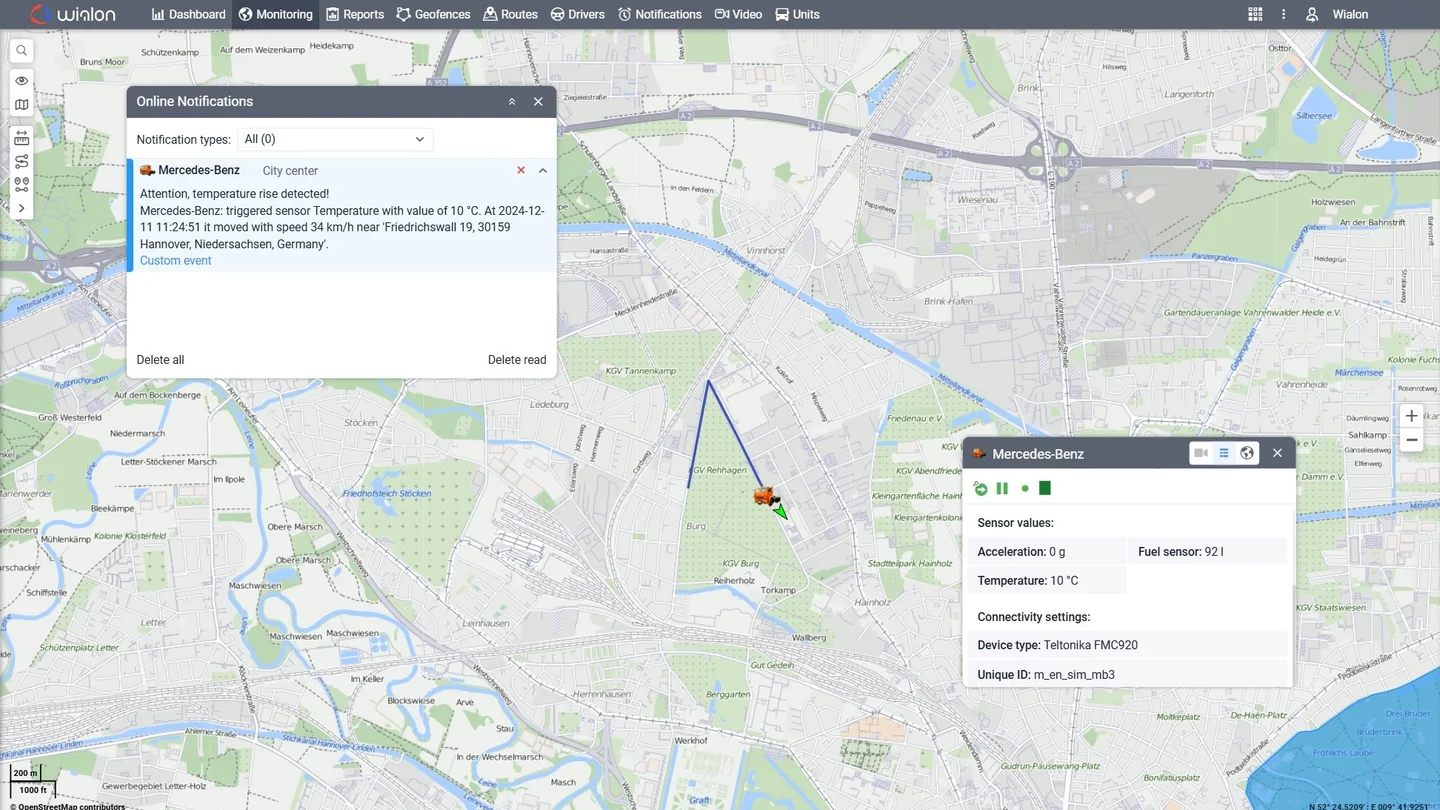
An alert with no recipient is noise. Every notification scenario we switch on has an owner and a response path first. An alert nobody is required to read stops being read by anyone within a fortnight.
Reports shaped around your billing. Mileage, driver hours, vehicle utilisation, driving style, cost per 100 km. We configure templates around the way you bill, not the other way round.
Installation and connectivity
Device classes per vehicle type are covered above. Two things remain, and they drive the schedule rather than the specification.
Installation costs vehicle time, not only money. OBD and two-wire trackers are fitted by your own staff or our partner — around a quarter of an hour per vehicle. FMS installations with CAN and a tachograph always go to a certified workshop, and the vehicle is off the road for several hours. Across a fleet of fifteen that is a question of sequencing, not of price.
SIM: ours or yours. We supply a SIM with a matched plan (1NCE or a Polish carrier), or provision your own corporate card. For vehicles crossing borders only one thing matters: whether the plan works in roaming. A device without transmission buffers its data and sends it when coverage returns — but a missing roaming plan usually surfaces a month later.
Platform variants
Wialon is Gurtam’s telematics platform, used in more than 150 countries. The reasons we stand on it are above; what remains is which variant.
- Wialon Hosting — SaaS, fastest to deploy, the default for most fleets.
- Wialon Platform — self-hosted and white-label, for when the data must stay in your infrastructure or the system is resold under your brand.
- GPS-Trace — for very small fleets, where the full platform is overkill.
Data leaves every variant the same way: through the open API into an ERP, a TMS or a warehouse. We cover that on the Wialon integrations page.
Why calibration takes weeks
First data appears on the map within 48 hours. Data you can base a conversation with a driver or an invoice on takes two to four weeks — and that is the stage most often left out of a proposal.
Three things make it up. Alert thresholds taken from a catalogue produce hundreds of notifications in the first week, half of them false; tuning them means watching how the fleet actually drives. Fuel sensors need a controlled fill and a calibration curve — without one, a fuel report shows numbers rather than values. Reports have to be reconciled against whatever the company counted by hand until now, and every discrepancy explained before anyone trusts them.
Only after that is the data fit for billing. A supplier promising both on the same day is simply skipping the stage — and the cost is the credibility of the first report shown to the team.
Fleet tracking versus tracking single vehicles
With two or three vehicles a map and trip history are enough. With a fleet something else begins: nobody reviews twenty trips a day. Fleet tracking is first of all structure — vehicle groups matching branches or job types, permissions where a manager sees only their own vehicles, and aggregate reports instead of individual journeys.
The arithmetic changes too. Per-vehicle cost falls as the count rises: the platform licence and the rollout work spread across the whole fleet, and fitting is scheduled in batches rather than as single visits. That is why a fleet quote does not look like the sum of unit prices; we break it down on the pricing page.
The third difference is alerts. With one vehicle the owner reads the alert. With twenty, an alert without an assigned recipient is simply ignored — so in fleet rollouts every alert scenario gets an owner and a response path before it is switched on at all.
Compliance: GDPR and the Labour Code
Monitoring company vehicles is legal in Poland but comes with formalities. In practice you need three things: a lawful basis and purpose for processing under Article 6 GDPR; the rules written into work regulations or a formal notice, with employees informed at least two weeks before go-live; and visible marking of the monitored vehicles.
Private journeys are a separate question. Where the company allows personal use outside working hours, we configure a private mode — the fact of the trip and its distance are recorded, but not the route. That is a standard part of the rollout, not an extra.
Where to start
The cheapest start is a single test vehicle with the full configuration: you see real data from your own fleet before committing to scale. What that looks like in practice is on the fleet tracking demo page. We also prepare a quote covering devices, installation, SIM cards and platform access, usually within 24 hours — the cost breakdown is on our pricing page.
Frequently asked questions
How long does a GPS fleet tracking rollout take?
Platform and account configuration typically takes 48 hours from order confirmation. The real timeline depends on installation — OBD and two-wire trackers take minutes per vehicle, while CAN-based FMS units with tachograph download need a workshop visit. Budget another two to four weeks of calibration before the data is fit for billing.
Is tracking company vehicles legal in Poland?
Yes, provided GDPR and Polish Labour Code obligations are met. Employees must be informed about the scope and purpose of monitoring at least two weeks before it starts, the rules go into the work regulations or a formal notice, and monitored vehicles must be marked. Monitoring outside working hours is not permitted, which is why we configure a private mode.
Can GPS alone detect fuel theft?
No. A GPS module shows trips and stops but not tank level. Detecting losses requires either a capacitive fuel level sensor or a CAN/OBD reading. Only the combination of refuelling transactions and actual tank level gives a defensible picture.
What happens to the data when the contract ends?
Trip history and reports stay available for export throughout the subscription. Before it ends we hand over a full data export and wind down the accounts on an agreed schedule.
How is fleet tracking different from tracking single vehicles?
Technically it is not — same devices, same platform. The difference is organisational: a fleet needs vehicle groups and permissions, aggregate reports instead of individual trips, and a per-vehicle cost that falls as the count rises. Groups and roles are configured during the rollout, so a branch manager's report shows only their own vehicles.
Does tracking work outside Poland?
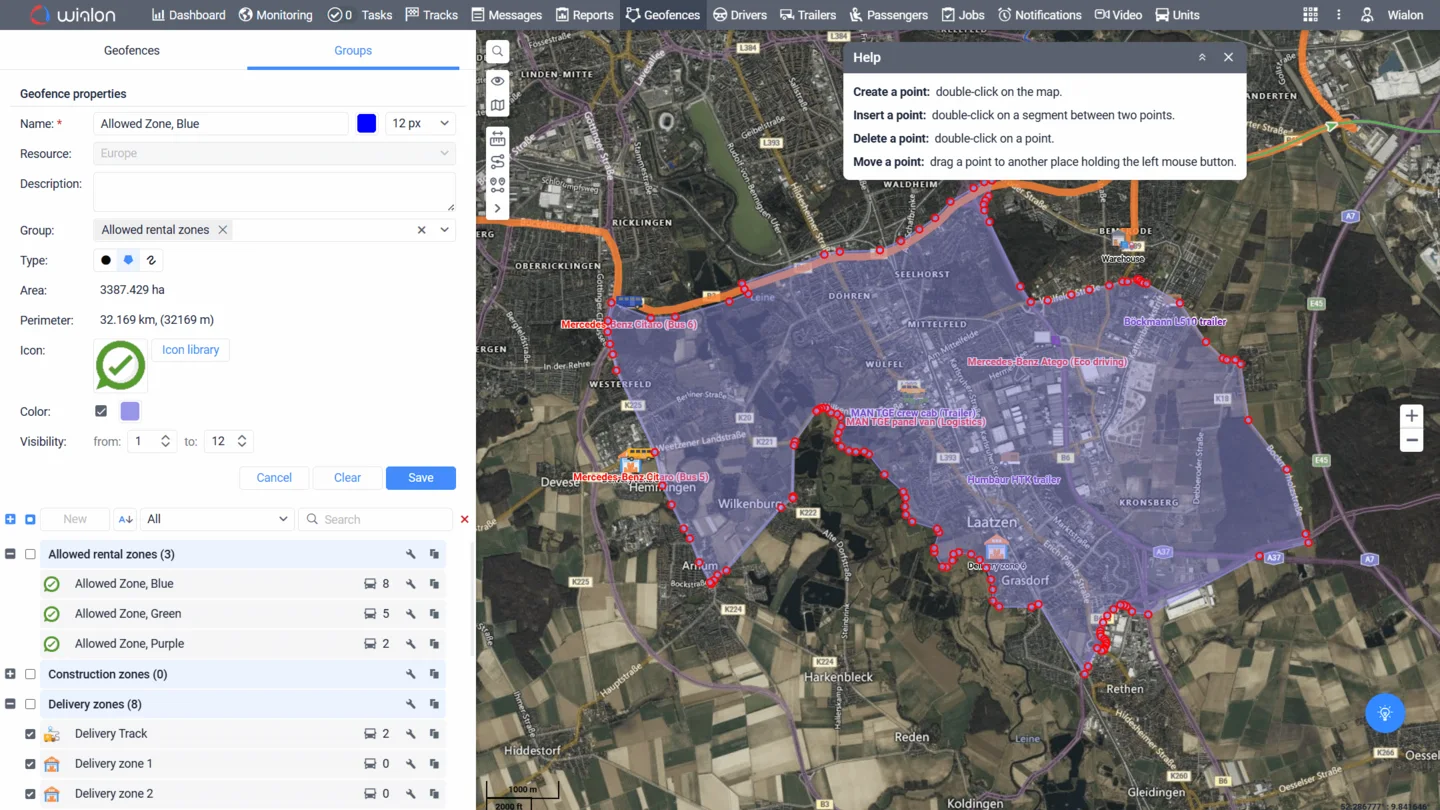
Yes. Devices run on SIMs with European roaming (1NCE or a Polish carrier) and the platform has no geographic limits. For international fleets we configure geofences and border-crossing reports.